
Comp Photos and MLS, Fannie, USPAP, etc.

To keep up on what is happening in appraisal businesses, mortgage lending, USPAP, etc. , Plus humor and strange homes, sign up for my FREE weekly appraisal email newsletter, sent since June 1994. Go to Home on the left side of the menu at the top of this page or go to www.appraisaltoday.com
Sign up in the Big Yellow Boxes

I regularly write about hot topics in appraising and appraisal business management issues
in my paid Appraisal Today monthly newsletter.
$99 per year or (credit card only) $8.25 per month, $24.75 per quarter, or $89 per year.
For more info, go to https://www.staging.appraisaltoday.com/products


Appraisalport polls on comp photos from June 2015

By Steve Costello,

This month I want to discuss three recent polls dealing with comp photos. In the first poll, we asked “With the availability of MLS photos, do you still feel it is necessary to drive by and photograph every comp?” We had a total of 3819 responses and the top two answers were very close. The winner, with 40 percent of the vote, was “Sometimes, it depends on the complexity of the specific assignment.” Coming in a close second was “Yes, I always want to see any property I use in a report” with 38 percent of the vote. The final answer of “No, I would rather just use MLS photos” only scored about half the votes as the first two answers, finishing with 22 percent. This makes sense because I think most appraisers want to look at a comp before they include it in a report, especially if they aren’t already familiar with the property. I can also see where some appraisers are very familiar with the properties in their area, use many of the same comps over and over again, and don’t feel a need to drive by and photograph them every time they use them.

In the next poll, we asked “In your opinion, with MLS, Google, and other photo sources available to clients, the main reason original comp photos are required from the appraiser is:” This poll had 3986 responses and had a pretty clear winner. A full 63 percent of the appraisers chose the answer “To make sure the appraiser actually drives by the comps.” So it looks like most appraisers don’t think their clients care as much about the actual photo compared to just making sure the appraiser actually visited the comp. The answer we expected to be very popular, “To provide the client with up-to-date photos of the comps – ensuring they exist in the stated condition,” only received 22 percent of the vote. A third response of “So the clients won’t have to take the time to look up the photos from one of the sources noted above” didn’t do well, only pulling in 3 percent of the vote. Not a surprise — we didn’t really expect many appraisers to choose that answer. Finally, 13 percent of appraisers went with “Other reason” as the best choice for this question. We really don’t know if there were one or many “other reasons” or what they are.

Finally, we asked “Would you be in favor of eliminating the requirement to include an original photo of every comp as long as a recent MLS photo of the property could be included with your report?” This question was very popular with 4770 total votes. It also produced a landslide vote with 79 percent of the appraisers selecting the answer “Yes.” Only 15 percent answered “No” and would not want to use an MLS photo instead of an original if it were available. A final 6 percent were “Not sure” how they felt about this issue. So, from this poll it is clear that appraisers feel that an original photo is not a necessity to produce a quality appraisal as long as a good representative photo is available from another source like an MLS.

My comment: As we all know, a photo taken at the time of listing from the MLS is often better than one taken later and USPAP does not require comp photos. Fannie Mae certifications require that the appraiser inspect the exterior of the comp, not take a photo. What about re-using a comp photo? Why the requirement of an “original” photo? To be sure appraisers drive by the comps.

Appraisal Humor

Appraisal business tips

A very, very funny appraiser video!

What does it cost to take appraisal comp photos?(Opens in a new browser tab)

Poll – Taking comp photos?(Opens in a new browser tab)

Appraisal Today newsletter

Appraisals-how long to write/how many per week

To keep up on what is happening in appraisal businesses, mortgage lending, USPAP, etc. , Plus humor and strange homes, sign up for my FREE weekly appraisal email newsletter, sent since June 1994. Go to Home on the left side of the menu at the top of this page or go to www.appraisaltoday.com
Sign up in the Big Yellow Boxes

I regularly write about hot topics in appraising and appraisal business management issues
in my paid Appraisal Today monthly newsletter.
$99 per year or (credit card only) $8.25 per month, $24.75 per quarter, or $89 per year.
For more info, go to https://www.staging.appraisaltoday.com/products

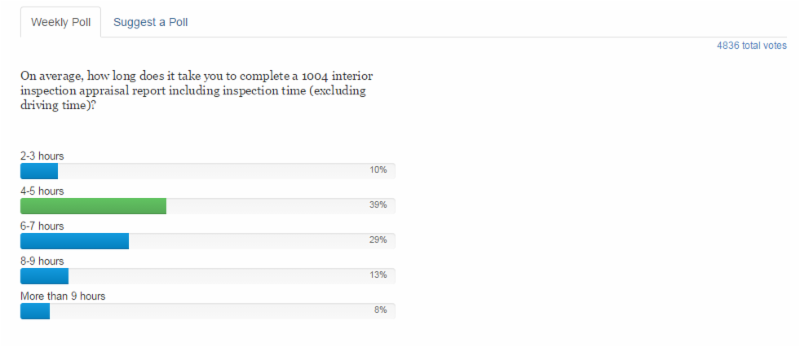
On average, how long does it take you to complete a 1004 interior inspection appraisal report including inspection time (excluding driving time)?

Another Very Interesting poll from May 2015

 My comment: I have been hearing about scope creep causing increased appraisal report writeup times but now there is some data. Significantly increased, and still increasing from pre-AMC days. My non-lender report writing time has not changed since before HVCC. Appraisalport is a lender portal, so I guess there are some appraisers that write fast and others that write slow. Or, maybe it depends on your clients. AMCs tend to combine the requirements of multiple lenders into very long lists of requirements.
—————————-

On average, how many “interior inspection” appraisals reported on a 1004 do you normally produce in a week?

My comments: Starting with a conforming tract home close to your office, the time increases, depending on driving time, use of an assistant and client requirements.

Appraisal Humor

Appraisal business tips

A very, very funny appraiser video!

Limiting Conditions and Assumptions Appraiser Humor(Opens in a new browser tab)

Appraisal Today newsletter

It’s Not a Comp, It’s a Sale – Lies, Damn Lies…and FNMA 'statistics'

Another “good one” by Dave Towne, Washington appraiser and commentator

Something’s been gnawing at my craw ever since January when FNMA’s wonderful CU was unleased to the world.  And before that, which still continues, is the AQM process they still use to judge the work of appraisers.

No one else has written about this, or even mentioned it, so I will: It has to do with the word “Comp” which is used liberally by FNMA.

What exactly is a “Comp?”

In FNMA’s world, it’s any property that they obtain, either by their vast AVM process which examines millions of property transactions, or properties that have been extracted from appraisal reports submitted by appraisers……..yes, your work.  In their fuzzy logic, it’s a “Comp” considered for your report if they say it is.  It is not!

A true “Comp” is a property viewed and/or analyzed by a real living, breathing, mirror fogging appraiser who compares that sold property against the subject property in terms of multiple features, characteristics and amenities.  It is not determined by an AVM or algorithm within the vast bowels of FNMA.  Until the property has such analysis done by an appraiser, it is merely a SALE……it is not a “Comp.”

This FNMA lie really became evident to me on 4/20/15 when FNMA released a news release about how CU has been integrated into their on-line Desktop Underwriter software mortgage lenders use, which you can read here:  http://www.fanniemae.com/portal/about-us/media/corporate-news/2015/6239.html?p=Media&s=News+Releases&from=RSS

Within that news release is this quotation from a VP at a mortgage lender:  “The collateral information that CU provides is invaluable and simply staggering,” said Breck Tyler, Executive Vice President, Trustmark Mortgage Services. “CU has aided in providing important comparable data that was previously unavailable or very difficult to get. CU messages in DU will help streamline appraisal review and make the underwriting of an appraisal a much more informed process.”

Then, FNMA released info directed to Correspondent Lenders who intend to use the CU process in UCDP, but don’t intend to sell the loan to FNMA:  https://www.fanniemae.com/content/fact_sheet/collateral-underwriter-non-seller-implementation-guide.pdf

That has this statement:  “Fannie Mae does not instruct or suggest to lenders that they ask appraisers to address all or any of the up to 20 comparables that are provided by CU for most appraisals.”

I want to repeat what I said above…in case you missed the point:  A PROPERTY IS NOT A “COMP” UNLESS YOU DETERMINE IT IS AND INCLUDE IT IN AN APPRAISAL REPORT.  Otherwise it’s just a ‘sale.’

If you’re an appraiser who liberally uses the word “Comp” in place of a ‘property sale’ I would ask that you be more careful.  If you receive info from a lender, AMC or anyone else who asks you to look at the “Comp” they have provided, correct them and use the words “sale property” until you have determined that it truly is a “Comp.”

I’m also asking members of appraisal organizations and associations to communicate your concern about this lie perpetrated by FNMA directly with them, and ask FNMA to change the word “Comp” used in their CU Reports, news releases, instructional materials, etc. to ‘Property Sales’ so that there is no misunderstanding about the significance of this issue.

If organizations and associations won’t do that on behalf of appraisers, then we might as well kiss the profession of residential real property appraising goodbye. Because if a list of ‘sales’ are considered “Comps” then an actual human appraiser won’t be needed to provide supportable property analysis and market value reports.

Dave Towne
dtowne@towneappraisals.com

www.towneappraisals.com
Mount Vernon, WA

My comment: I have been aware of the difference between a sale and a “comp” for a very long time. I try not to mix them up. It is very important when communicating with lenders and real estate agents, who should already know the difference. I am glad that Dave Towne points out this very big difference.

I have not found it to be an issue with non-lender clients, where I use “comparable sales” which is a much clearer term to use, since few are familiar with the term “comp”.

Appraisal Today newsletter

Newz Flash: Fannie Mae’s Collateral Underwriter Hacked!!!

A disgruntled man who lost his home to foreclosure did it!! The CU system is completely shut down. No details were available on when, or if, it will be fixed. The un-named man was not available for comment as he is reportedly hiding out in a remote cabin in the woods in a very rural upper Michigan or Canadian location.

He, his wife, and 4 children are now living in a Tiny House on his brother in law’s rural property in Michigan. They lost their suburban 4 bedroom home they had owned for over 20 years to foreclosure. The family has an outhouse, a hand pumped well and wood heat. A small solar power array is used for a computer and Internet connection with a few hours of electricity daily.

Who is in an uproar about this? 

– Not appraisers who don’t like a system that evaluates their appraisals but they don’t know the criteria.
– Not underwriters who are required to learn a new system and do manual reviews of appraisals before sending warnings to appraisers.
– Not loan officers whose deals are taking longer to close. Not borrowers who have to wait longer to get their loans approved.
– Not law enforcement, who don’t think he is a terrorist or a nut holed up with a lot of guns.

FYI, it is April 1 today. You know what that means ;>

Appraisal Today newsletter

CU – subject vs. comp data. I want the subject data!!

Fannie says that typically there are around 7 UAD records per property. However, most of them must be from appraisers who used it as a comp. Why should we be compared with appraisers who used the property as a comp?

I want access to CU property data from appraisers who did an appraisal on the subject property, not from appraisers who used it as a comp. I want CU to use this data to compare my appraisal data with “peers”. Comp data is not very reliable as it usually comes from MLS and public records. Fannie says that MLS and public records are not as reliable as data from the appraiser who appraised the property for the sale.
Maybe the appraiser had seen the interior of the comp recently, but this is very unlikely. Also, I go on the MLS tour/caravan almost ever week, but I don’t spend a lot of time at each open house. Well..I do spend more time if there is good food ;> MLS photos are subject to interpretation as they are done for sales purposes. I make brief notes on the flyers and file them in binders, going back to 1990.

Appraisal Today newsletter

Fannie’s new Collateral Underwriter (CU) FAQs updated

Fannie’s new Collateral Underwriter (CU) FAQs updated – not dated but available on Feb. 25
Why does Fannie keep saying appraisals there will be minimal, or no effect, on appraisal turn times? The real estate agents are worried about delaying closings.
For now, since few appraisers are receiving warnings, the underwriters appear to be slowing down the processing as they are responsible for decided which, if any, warnings to send to appraisers, after reading the 30+ page appraisal reports.
These FAQs mostly clarify what they have said before, but there is some interesting new information.
The first two pages has the new FAQs updates,
Here is some of the new info:
– Fannie Mae does not instruct or suggest to lenders that they ask the appraiser to address all or any of the 20 comparables that are provided by CU for most appraisals.
– (Underwriters) Carefully review the appraisal report before seeking additional clarification from the appraiser based on CU findings.
– Fannie Mae expects lenders to use human due diligence in combination with the CU findings, and will actively follow up with lenders who are reported to be asking appraisers to change their reports based on CU findings without any further due diligence by the lender.
– Fannie Mae encourages lenders to carefully review the appraisal report – including all commentary – before seeking clarification from the appraiser. Don’t assume the appraiser is wrong just because you see a CU message. Taking messages or alternative sales at face value and simply asking your appraiser to address them is neither effective nor efficient. CU is intended to supplement a lender’s human due diligence. After completing a thorough review, lenders should be able to have constructive dialogue with appraisers to resolve specific appraisal questions or concerns. Lenders should not, however, make demands or provide
instructions to the appraiser based solely on automated feedback.
It is also available on the main CU link at www.fanniemae.com/singlefamily/collateral-underwriter

Appraisal Today newsletter

Collateral Underwriter – appraisal access to data and CU

Should CU be transparent? Poll results
Poll results from ICAP poll – Illinois Coaltion of Appraisal Professionals, a very active appraisal political action group. www.icap.com
—————————–
Excerpt:
A few of the results of the 10 questions:
Q1 Should Fannie Mae make CU transparent?
Yes – 89%
No – 6%
Uncertain – 5%
Q3 Will CU risk scores cause Lenders and AMC clients to request appraisers to fit comps to the CU model?
Yes – 69%
No – 5%
Uncertain – 26%
Q5 Do you think the intent of CU is to
replace the appraiser?
Yes – 53%
No – 25%
Undecided – 22%
Download the results
—————-
Online petition to allow appraisers access to CU UAD data
ICAP also has a petition to Fannie Mae that created 11/10/14. “Online Petition to allow appraiser access to data they provided through the Uniform Appraisal Dataset (UAD).”
Excerpt:
The GSE’s have mandated that all appraisals be submitted in the UAD format; however, currently there are no plans to provide appraisers access to this data.
This data needs to be provided to appraisers at the beginning of the appraisal process; ensuring transparency, and improving the process by reducing risk to lenders and the general public.
Sign the petition at http://icapweb.com/petition.php  Plus read the very interesting comments from appraisers!!
————————–
My opinion: I support the petition asking Fannie to let appraisers get the data that we submitted!! CU transparency is more difficult, for various reasons.

Appraisal Today newsletter

Appraisal adjustments "The Dirty Little Secret"

A Few CU Factoids
– Not all loans go to Fannie – VA, FHA, jumbo, etc.
– Fannie guidelines, including CU, are the minimum. Lenders can add their own, even keeping 15-25% adjustments.
– Lenders are not required to use CU.
– CU sends out appraisal warning messages for adjustments on: GLA, lot size, view, condition, quality, and location. For now.
– Gradual implementation of CU’s web based interface, which has the infamous “20 comps”, mapping, etc. Not available to AMCs.
A few CU comments and opinions from me:
– I need a Book of Adjustments!!! Maybe a few of Fannie’s will “leak” – wiki leaks ;>
– AMCs are now asking for adjustment support from non-CU adjustments. More Scope Creep??
– Mass confusion on what gets sent from underwriter to AMC to appraiser – warnings, Risk Scores, etc.
– The recent Fannie Letter to Lenders about CU said that the intent is not to overwhelm appraisers with warning messages. But, are underwriters going to read (and understand) 30+ page appraisals? I’m glad I’m not an underwriter!!
– How to respond to warning messages – not clear.
– Requests from AMCs include CU and non-CU requests. Sometimes hard to tell where they are from.
Adjustments – the “Dirty Little Secret” of Fannie Form Appraisal Reports
I can’t think of any time a client asked me for my support on an adjustment prior to CU. They have been accepting the usual responses, which are in many boilerplates: Based on my many years… or matched paired sales… etc.

A critical issue to me is that the dollar adjustments seem to indicate that residential appraisal values are precise and very accurate, which is not correct. There are lots of factors affecting home sales as compared with income property such as apartments and commercial property.

I have asked many very experienced appraisers how they “support” adjustments. Most use “rules of thumb”, such as using a percent of price per sq.ft. for GLA. But, this number includes land. Or, they use adjustments they were given when they were new appraisers. Of course, if you only appraise conforming homes in conforming tracts built in the past 10 years, it is much, much easier.
For now, CU only sends out warning messages for these adjustments: GLA, lot size, view, condition, quality, and location. This is a very small percent of all the UAD coded data. Plus, some data is not UAD coded, such as pools. But, many state regulators expect to see support for all adjustments in your work files.
We all need a Book of Adjustments ;>
Of course, all of us have adjustments that we have accumulated over the years, or recently developed. But, with CU we are being compared to peer and model adjustments. Of course, no one tells us who or what they are. Sometimes appraisers are given this information.
Regression to support adjustments
Regression will not work for all adjustments. It works well in conforming tracts less than 10 years old. After that, it goes downhill. This has been shown many times for AVMs. I really wish I could just buy regression software and have it calculate them all for me!!
Using qualitative adjustments
I did my first SFR appraisals this week without not making any dollar adjustments when I use form reports for non-lending work. I did make time adjustments (which are very easy to support) as the effective date was June, 2014, when prices were increasing rapidly in my market.
I used plus and minus signs in the grid. I use the 2005 Fannie forms but do not use the Fannie certification or limiting conditions. I use my own.
For awhile in the late 80s or early 90s Fannie had a form with pluses and minuses, so I had some experience. Also I don’t use dollar adjustments in my 5+ unit apartments or commercial appraisals.

Appraisal Today newsletter

CU warning messages – grrrr

A few appraisers are reporting getting CU appraisal warning messages from AMCs. Some AMCs get the messages and and some don’t, depending on the agreement with their lender client.

I sorta believed all the “experts” who said CU would not affect appraisers much, except the many us who do not have market based adjustment support in our work files (which we should have always had). “They” said appraisers’ time for responding to AMC questions will not change. Fannie’s reviewers have been using CU for about two years. Some lenders beta tested it. They all liked it. But, I wonder if it was tested with “boots on the ground” appraisers who actually had to respond to the warnings??

In January I wrote up a long CU article for my paid Appraisal Today newsletter. In the February issue I will have another long article, focusing on the differences between the old and new CU warning messages. They are very different. AMCs with access to lender’s warning messages are sending them to appraisers, such as:

Old message (pre-CU): Condition adjustment for comparable property #<comparable number> appears excessive.
New message(CU): The condition adjustment [for comp #X] is smaller than peer and model adjustments
New (CU): The condition adjustment [for comp #X] is larger than peer and model adjustments.

There are other messages about condition ratings different that peers and model.

I don’t know how our “peers” and The Model made their adjustments or ratings and what they are. I don’t know how to respond as to why mine differ.

Now that appraisers are getting the warnings, they are asking how to respond to them. Who are these peers? What is the model? I have no idea how to respond, except to say “I don’t know who the peers are and how they determined condition or what method they used for their adjustment. I am unable to respond.” How do you know what the condition is really like for comps? There are lots of ways to estimate an adjustment for condition. You can explain what you did. But, who is right? You, peers, or model?

MLS is soo reliable (Not) for estimating comp condition. I don’t think they will like “matched paired sales” on all of your responses for the method you used for adjustments.

Looks like maybe there will have to be some webinars for appraisers, not just underwriters, explaining how to respond.

Appraisal Today newsletter

Appraisers not getting access to their own data on CU

There is a petition and a letter being circulated about appraisers getting access to CU, particularly the Web interface which lists comps. This is unlikely for many reasons, which I write about in my paid newsletter.

More important (and more likely to occur) is: Why don’t appraisers get access to subject and comp physical characteristics from the CU database, which was provided by appraisers using UAD?

For example, which appraisers are able to measure their comp GLAs? Not many. This data would really help appraisers do better appraisals. We can always look at MLS interior photos and interview agents, buyers, and sellers for other information we need, such as condition. When the MLS listing says “contractor special” or “fixer” that is a good indicator of condition.

The only reason I have heard is that appraisers vary widely and there are too many differences. GLA is a good example. This has has always varied among appraisers. When I used the old CMDC appraiser database in the late 1980s, sometimes there were more than one source of GLA on a property. I have done relocation appraisals since 1986. It was very seldom that the 2 or 3 appraisers have the same GLA. The “rule of thumb” was up to a 5% difference in GLA was ok.

How many appraisers are “fudging” their dimensions to make their GLA match public records and avoid “stips”? Hopefully, CU will change this. Maybe CU will notice how many appraisers just use public records and how many use their own measurements.

I am really hoping that Fannie allows appraisers to get property characteristic information. It will help all of us – Fannie, lenders, AMCs, appraisers, reviewers, etc.

Appraisal Today newsletter