
NOT customary and NOT reasonable fees?//TRID??

NOT customary and NOT reasonable fees?
What is reasonable? Let me see… For example, the amount of work to produce the appraisal plus respond to request for more information, updates, etc. increases the time from 5 hours ($70 per hour) to 8 hours ($47.50 per hour),  a 33% decline. Of course that is gross, not considering your expenses. You are able to get the same fee – $350. But, the fee is not reasonable. Calculate this for your typical appraisal fees.
What is customary? Somehow AMCs seem to think that “one price fits all”. Before AMCs took over, appraiser fees varied widely around the country. The Midwest was typically the lowest, around $250. The West Coast (Washington and Oregon) and some East Coast states were higher, around $450. Alaska and Hawaii were much higher. We accepted “standard” fees from our clients as we took the easy appraisals and the hard appraisals, which balanced out. I didn’t ask for a fee increase when a property took more time. If was a high end home or a rural acreage property, the lenders paid higher fees. Or, we scheduled appraisals to reduce driving time. Clients understood that they could not give us all the hard appraisals and appraisals scattered over a wide geographic area.
Now, AMCs have standard fees, but they don’t consider the factors above. Many appraisers have responded by asking for fee increases or just turning down the assignment.
——————————————–
TRID vs. the current system of AMC ordering appraisals
TRID will make the method above (“one fee for all appraisals”) very difficult for AMCs. Lenders have to provide an appraisal fee within 3 days. AMCs won’t be able to spends days “shopping” for the lowest fee for a tough appraisal. AMCs won’t have time to negotiate with appraisers. Yes, there are options but they delay the loan.
Now, appraisers can quickly accept broadcast orders with the expectation of getting a fee increase. After Oct. 3, that will create problems for lenders and AMCs.
What will happen? How can AMCs tell their lenders what to charge for a specific appraisal (the full cost, including AMC fees) within a few days? Their systems assume all appraisals are the same. I doubt if they have anything set up to distinguish complex rural from a tract home. Can AMCs even quote different fees within a state? I see AMCs making less money because the appraisal fees they pay will increase. Now, they are waiting for appraisers to tell them that the fee has to be higher.
What does this mean for appraisers who work for AMCs? Higher “standard” fees to cut down on appraisers refusing fees? This cuts into AMC profits unless they can get higher fees from their lender clients. But, AMCs compete with other AMCs. Fees are a big factor when a lender selects an AMC.
I have no idea what will happen. I am glad I don’t own an AMC with lots of lender clients. Maybe they will never raise appraisal fees for difficult properties. But, who will do them?
Volume is high now and AMCs have difficulty finding appraisers to do the tough appraisals and FHA appraisals. When volume is low and appraisers need the money, the “one fee for all” is easier for AMCs to use.

Appraisal Today newsletter

FHA – Crawl space and attics

To keep up on what is happening in appraisal businesses, mortgage lending, USPAP, etc. , Plus humor and strange homes, sign up for my FREE weekly appraisal email newsletter, sent since June 1994. Go to Home on the right side of the menu at the top of this page or go to www.appraisaltoday.com
Sign up in the Big Yellow Boxes

I regularly write about appraisal business management issues
in my paid Appraisal Today monthly newsletter.
$99 per year  or (credit card only) $8.25 per month, $24.75 per quarter or $89 per year.
For more info, go to https://www.staging.appraisaltoday.com/products

FHA – Crawl space and attics

Random Internet postings….
Man killed in crawlspace of Oklahoma City home, may have been electrocuted
—————————-
Posted on facebook, reportedly from FHA employees:
– If you can fit through the crawlspace door you must crawl the crawl space and inspect it all.
– Must inspect all the attic if there is access, even if there is no flooring.
My comment: If you’re fat, don’t have to inspect all of the crawlspace? Lots of stories about snakes, rats, dead animals, etc etc in crawl spaces. Appraisers crawling along ceiling joists and going thru the ceiling. Hmm… maybe FHA appraising is for the young, agile and small ;>

Appraisal Today newsletter

Revised FHA Handbook 4000.1 effective 9/14/15. Are you ready for the changes? Get the facts!!

 What you need to know and which FHA documents you need to read!! 
Available in my paid August Appraisal Today August newsletter!!

Many appraisers say they will quit doing FHA appraisals. 
This means less competition for you!!

There is lots of confusion and mis-information about the changes. Some say there is too much required and others say there have not been many changes. What about attic, crawl space, and appliance inspections?

The author, Doug Smith, SRA, interviewed an FHA executive to find out what is really happening.

There are different FHA documents you need to read, not just Handbook 4000.1. It is very confusing, but Doug tells you what information you need and where to get it. He includes:

  • Which guide to use for what, and links to the reference material, including FAQs, Webinars, and SF Housing Appraisal Report and Data Delivery Guide
  • How to keep updated on changes
  • Attic, crawl space, and appliance inspections
  • Energy efficient items contributory value
  • Highest and best use – when all 4 criteria are required
  • FHA – UAD and Fannie guidelines

And lots more information.

Appraisal Today newsletter

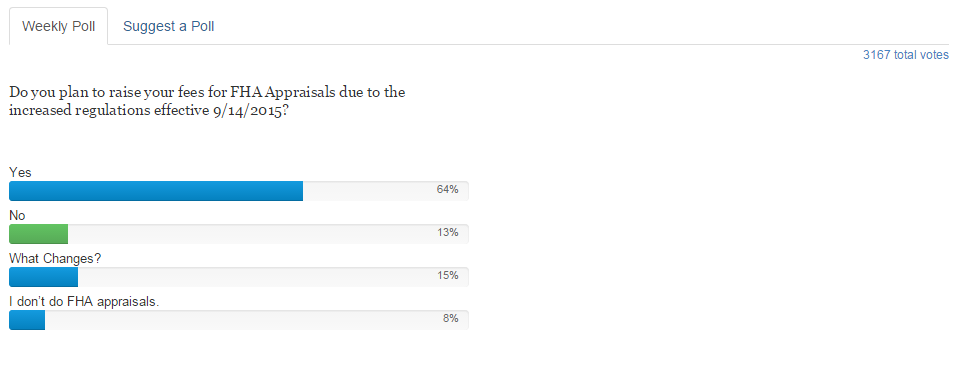
FHA appraisal fees going up after 9/14/15?

Another great survey from www.appraisalport.com !!

7-9-15 fha fees poll.png

My comments: Whether or not there will be increased time (and possible liability issues) required is controversial. Some say there are more requirements, others say not much has changed. My favorite response to the poll is “What changes?” ;>

In the May 2015 paid Appraisal Today June newsletter, Doug Smith’s article discussed the changes: “What’s Up with FHA’s New Manual 4000.1? More Scope Creep? The pluses and minuses of the changes in the manual”. One of the hot topics is about inspecting attic and crawl spaces. For more info on the paid newsletter, click the banner ad below.

FHA Single Family Housing Policy
Handbook (HUD Handbook 4000.1
Information Page Link:
http://portal.hud.gov/hudportal/HUD?src=/program_offices/housing/sfh/handbook_4000-1

New FHA Appraisal Report and Delivery Guide
It goes step-by-step through the URAR and states what is expected in each section
http://portal.hud.gov/hudportal/documents/huddoc?id=SFH_POLI_APPR_RPT_FIN.PDf
Be sure that any FHA classes you take include this new Guide!!

Appraisal Today newsletter

Appraisals-how long to write/how many per week

To keep up on what is happening in appraisal businesses, mortgage lending, USPAP, etc. , Plus humor and strange homes, sign up for my FREE weekly appraisal email newsletter, sent since June 1994. Go to Home on the left side of the menu at the top of this page or go to www.appraisaltoday.com
Sign up in the Big Yellow Boxes

I regularly write about hot topics in appraising and appraisal business management issues
in my paid Appraisal Today monthly newsletter.
$99 per year or (credit card only) $8.25 per month, $24.75 per quarter, or $89 per year.
For more info, go to https://www.staging.appraisaltoday.com/products

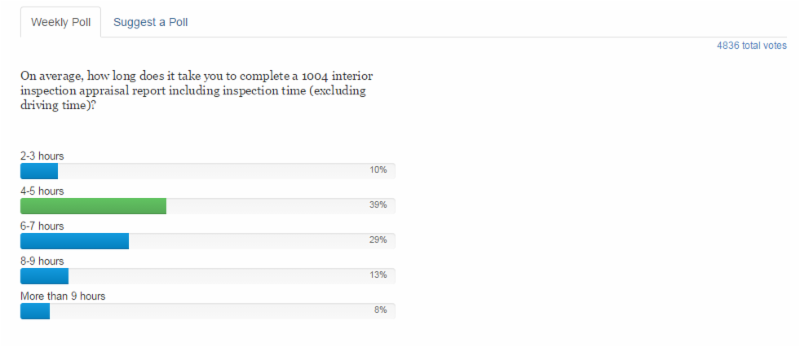
On average, how long does it take you to complete a 1004 interior inspection appraisal report including inspection time (excluding driving time)?

Another Very Interesting poll from May 2015

 My comment: I have been hearing about scope creep causing increased appraisal report writeup times but now there is some data. Significantly increased, and still increasing from pre-AMC days. My non-lender report writing time has not changed since before HVCC. Appraisalport is a lender portal, so I guess there are some appraisers that write fast and others that write slow. Or, maybe it depends on your clients. AMCs tend to combine the requirements of multiple lenders into very long lists of requirements.
—————————-

On average, how many “interior inspection” appraisals reported on a 1004 do you normally produce in a week?

My comments: Starting with a conforming tract home close to your office, the time increases, depending on driving time, use of an assistant and client requirements.

Appraisal Humor

Appraisal business tips

A very, very funny appraiser video!

Limiting Conditions and Assumptions Appraiser Humor(Opens in a new browser tab)

Appraisal Today newsletter

CU warning messages – grrrr

A few appraisers are reporting getting CU appraisal warning messages from AMCs. Some AMCs get the messages and and some don’t, depending on the agreement with their lender client.

I sorta believed all the “experts” who said CU would not affect appraisers much, except the many us who do not have market based adjustment support in our work files (which we should have always had). “They” said appraisers’ time for responding to AMC questions will not change. Fannie’s reviewers have been using CU for about two years. Some lenders beta tested it. They all liked it. But, I wonder if it was tested with “boots on the ground” appraisers who actually had to respond to the warnings??

In January I wrote up a long CU article for my paid Appraisal Today newsletter. In the February issue I will have another long article, focusing on the differences between the old and new CU warning messages. They are very different. AMCs with access to lender’s warning messages are sending them to appraisers, such as:

Old message (pre-CU): Condition adjustment for comparable property #<comparable number> appears excessive.
New message(CU): The condition adjustment [for comp #X] is smaller than peer and model adjustments
New (CU): The condition adjustment [for comp #X] is larger than peer and model adjustments.

There are other messages about condition ratings different that peers and model.

I don’t know how our “peers” and The Model made their adjustments or ratings and what they are. I don’t know how to respond as to why mine differ.

Now that appraisers are getting the warnings, they are asking how to respond to them. Who are these peers? What is the model? I have no idea how to respond, except to say “I don’t know who the peers are and how they determined condition or what method they used for their adjustment. I am unable to respond.” How do you know what the condition is really like for comps? There are lots of ways to estimate an adjustment for condition. You can explain what you did. But, who is right? You, peers, or model?

MLS is soo reliable (Not) for estimating comp condition. I don’t think they will like “matched paired sales” on all of your responses for the method you used for adjustments.

Looks like maybe there will have to be some webinars for appraisers, not just underwriters, explaining how to respond.

Appraisal Today newsletter

CU – census tracts, adjustments, "bad apples", etc.

There is a lot of misinformation about CU. No one knows what will happen when CU is fully implemented. I speculate myself. I am an appraiser. I have opinions ;>

UAD is mechanical. CU is asking appraisers to think about their appraisals, not how to classify a characteristic.

For the appraisal profession, I think CU will make us better appraisers by making us take a critical look at adjustments. It will also help get rid of the “bad apples”, including appraisers that “push” values, throw anything into the form to get it out the door, need lots more training and education, etc.

I think Fannie’s main purpose of CU may be to stop appraisers from having low (or high) adjustments, inappropriate comps, using Q/C ratings, etc. to make values higher. That is what they worry about.

Only using comps from within the subject’s census tract is ridiculous and I’m sure CU will not be doing this. It is a good idea to see which census tracts match the neighborhood boundaries that you use. Or, part of Census Tracts. Then you can put the census tracts you use in your appraisal. In some areas census tracts are way out of date due to new construction, plus other problems.

To find census tracts near any property, go to http://www.huduser.org/qct/qctmap.html and type in an address.

I started my business in 1986 and had to put census tract numbers in my appraisals for the first time. I had previously worked for an assessor’s office and had never done a lender appraisal. I used Thomas Brothers Census Tract books to find them. To me, they often represented a reasonable way to delineate all, or part of, a neighborhood. Looking at the current census map for Alameda, CA, my city (population 75,000), it definitely did a good job of defining neighborhoods. However, I usually have to include more than one census tract as there is not enough data to do an appraisal otherwise. It did miss one very important neighborhood where most of Alameda’s large historic homes are located. There is a significant premium for being in this neighborhood. I very, very seldom go out of this neighborhood for comps. I suspect there are issues like this in other geographic areas. I have no idea what area Fannie would use, so I would put an explanation in my appraisal.

The problem is the forms, which were developed for use on tract homes. If you are not appraising a conforming tract home, it is like trying to put square boxes into round holes.

Every appraisal will have a risk score. A high risk score (1.0 to 5.0, where 5.0 is high risk) does not mean an appraisal is “bad”. It may be in an area of declining values or have a negative location problem. Or, not enough comps to provide a reliable value.

Remember that only certain UAD items will be considered by CU for now. If it is not UAD formatted, it will not be looked at. I don’t think Fannie’ use of census tracts will be the issue.

The Big Issue is support for adjustments. I have no idea how to support all the adjustments I make in my appraisals. I know what buyers will pay more, or less, for. But, I don’t know the exact dollar amount.

Regression is just one way to support adjustments, but it will not work for many adjustments, particularly if there are very few sales. Regression is not the only answer. There are many other methods. I will be writing about them in my paid email newsletters.

Regression works very well for time adjustments. Be sure yours are market based, not just from an MC form.

I am seriously considering not making any dollar adjustments when I use form reports for non-lending work, except time adjustments. I never make dollar adjustments on narratives and apartment form reports. My state regulator wants to see support in my files for adjustments.

Just because there is a box does not mean it has to be filled in. Qualitative adjustments are fine. There was a Fannie form developed and used for awhile in the 80s or early 90s that did not use dollar adjustments, only plus or minus signs. I worry about that a lot. The old Fannie 2-4 unit form did not have any adjustment boxes. I really hated when they changed that form to include adjustment boxes and de-emphasize the Income Approach.

No one knows how CU will work out. Will everyone turn down appraisals except for conforming tract homes? Will there be no one to do the tough appraisals and work in rural areas. When appraisers are compared, does the majority opinion win?

Will the days of 24 hour turn times and $200 fees be gone? Will AMCs stop broadcasting all appraisal orders to everyone on their fee panels? Will all appraisers be seen as the same and interchangeable? Or, will appraisers be rated on skills, education and experience? Will fees go up? Will fees be based on difficulty of the appraisal? Will lots of appraisers abandon the lender appraisal ship of fools?

Read the webinar pdfs and look at the maps from the two Fannie Webinars to see what they actually are doing. I spent lots of hours doing this, plus speaking with others about what they thought. Of course, it was for a 12-page article in my paid newsletter. Plus 18 pages of excerpts from Fannie documents and webinars. I probably would not have done it otherwise ;>

Go to www.fanniemae.com/singlefamily/collateral-underwriter and listen to Fannie’s two webinars for underwriters – very good with excellent illustrations and explanations. Plus, read the FAQs. You need to register, but it is very easy and you go directly to the webinar and can return at any time. There are lots of links on the web page for more information.

Last month’s January 2015 issue of the paid Appraisal Today newsletter had a 12-page article on CU plus 18 pages of addenda material. The February and subsequent issues will address problems such as how to make adjustments. Click the ad below for more information.

Appraisal Today newsletter

Fees and getting C/R vary widely-per www.AppraisalPort.com polls

Fees and getting C/R vary widely – per www.AppraisalPort.com  polls

As you can see above, appraisers say that 60% or more of their  clients are paying C/R fees

As you can see above, only 9% of appraisers say C/R is under $350. Yet, I suspect that many are working for under $350 fees. Looking at the poll above,  60% or more of respondents say are working for C/R fees. Are most of them doing a lot of non-lender work, VA appraisals, AMCs who pay C/R, or direct lenders?

As you can see from the two polls, they show that 60% of residential appraisers say they are getting $400 or more per appraisal. If you’re not in the 60%, its time to change.

But, somehow the results seem strange to me. With AMCs at about 80% of the lender market and limited non-lender work available (as compared with commercial appraising) who are the 60% of the appraisers working for? If it is accurate, it means there are lots of clients paying C/R fees…

If you want to get higher AMC fees, you must:
1. Ask for higher fees and
2. Dump cheap AMCs
3. Only bid on jobs that won’t take much time and have few revision requests
Why don’t appraisers do this? Fear and Greed, just like all other businesses. Fear – afraid they will never get another appraisal job. Greed – want more money now. You have to overcome this to be successful in today’s very competitive AMC appraisal market. It is your choice to work for low fees and very demanding clients.

Next month’s paid Appraisal Today newsletter will have an article on how to overcome Fear and Greed and get higher fees.

Appraisal Today newsletter

Lender and AMC revision requests

Lender/AMC revision requests
By Steve Costello
Source: AppraisalPort monthly newsletter

My comment:  www.appraisalport.com  recently redid their web site and somehow their surveys got put on another page. Now, they are back. AppraisalPort has my Most Favorite Appraisal Surveys!! The current poll is about what measuring device appraisers use. Be sure to vote!! Their poll responses were typically very high, 4,000 to 6,000 responses.

——————-
Full article below:

First, I am glad to report that the poll is back up and running on the AppraisalPort homepage. It was down for a few weeks during the transition to the new version, but you can now find it by either scrolling down a bit or by just clicking on the button that says “Weekly Poll” on the right side of the screen.

This month, I want to discuss a couple of recent polls related to lender/AMC revision requests. First we asked: “Compared to a year ago, my lender/AMC revision requests have…?” Out of the 5019 responses, nearly 40 percent went with the answer “Stayed about the same.” Unfortunately the second most popular answer of “Increased significantly,” which took 21 percent of the vote and was followed closely by “Increased somewhat” with 19 percent. These were followed by the responses of “Decreased somewhat” pulling 13 percent of the vote and finally, “Decreased significantly” with a 7 percent share. There are two ways we can look at this data: Taking a negative view, 40 percent of the appraisers are experiencing some kind of increase in revision requests. That is a big number, but looking on the positive side that means that the other 60 percent have either stayed at the same level or have experienced a decrease in revision requests.

In the second poll we asked: “On average, how much time do you spend making and delivering requested revisions on any given appraisal?” We had a total of 4870 responses to this poll. Nearly half (48%) of those chose the response of “10-30 minutes.” This would seem about right for most minor to moderate revisions. Many must be making pretty minor revisions because the second most popular response with 24 percent of the vote was “Under 10 minutes”. Another 18 percent are having to take a bit more time and went with the choice of “31-60 minutes.” A smaller group of 7 percent is having to invest some real time to make the revisions and picked the response of “Over an hour.” The final 3 percent selected the answer of “I don’t make revisions.” I’m not sure if that means they are doing an amazing job on every report and never get a request or if they just refuse to do any revisions!

My comment: these results are somewhat similar to the recent Valuation Review survey results. I keep hearing lots of complaints about revision request hassles. It is good that it seems to be stablizing. Interesting results. I hardly ever have revision requests from my estate clients, except when I have a typo on the address or client name ;> I really hate getting reviewed!! Well… maybe it would be okay if it is an experienced local appraiser who knows all about my market!! I have always wondered why lender appraisals have been regularly reviewed. I don’t know of any other profession where someone else reviews so many reports that are done. I really think this is why appraisers are so negative about other appraisers’ work. I can’t remember if I took the poll… I often don’t because I don’t do any lender work and it sorta skews the results…

What do you think? Post your comments below!!

Appraisal Today newsletter

Where Did All the Good Appraisers Go?

Where Did All the Good Appraisers Go?

By Hamp Thomas, Institute of Housing Technologies

Excerpt:

As appraisal fees go downward, quality is going in the same direction. The best appraisers, who have invested years and years in building their careers don’t want to work for a company that they have to check in with every 12 hours, and get treated like a school kid in the principal’s office. An untrained and unlicensed person on the other end of the phone is making their schedule and deciding who gets paid what. And guess what – it’s going to get worse… The best appraisers are finding other types of appraisal work (that values their craft), and the appraisers that work on mortgage loans are often the newer licensees or trainees. If all this Reform we’re talking about is still hoping for higher quality appraisals for use in mortgage lending, we’re in deep trouble. The best appraisers are leaving mortgage appraising as fast as they can.

Appraisers get together and discuss how “bass ackwards” all this “reform” is, and why something that is so logical has been stretched far enough that the government is biting; hook, line, and sinker… If you want a higher quality product, you have to pay more. Look around. Do the best doctors get paid more? How about the best mechanics? The best architects? The best teachers and speakers? The best attorneys? People seek out the best and they are in such great demand, they command higher fees. This is nothing new, it’s just the way the system is supposed to work. So why do we think that appraisals should be different? The lenders, and government officials, and AMC’s think appraisers can be paid less, be required to do more work in each report, and then the quality of appraisals will go up? Come on, this is not rocket science. In most cases, when you add a middleman to any process the price goes up and the quality goes down. Ask Walmart…

http://www.housemeasures.com/ArticlePages/Where-Did-All-the-Good-Appraisers-Go–.html

My comment: AMCs, and the lenders that hire them, see all appraisers as the same. Why not go for the lowest fee? Yes, there are direct lenders who care, and big lenders who have “special lists” of experienced and well trained appraisers, typically for high end homes or people who are top bank customers. Those appraisers are paid much more than the appraisers who compete on fee.
Appraisal Today newsletter